Bromopentafluorobenzene: History, Science, and Prospects
Historical Development
Chemists began paying real attention to halogenated benzene compounds as early as the 1950s, searching for useful building blocks in organic synthesis. Among the perfluorinated aromatics, bromopentafluorobenzene stuck out for offering a unique combination: heavy halogen reactivity from the bromine and electron-deficiency from all those fluorine atoms. It owes its discovery to the growing interest in organofluorine compounds during the boom in plastics and pharmaceuticals around the late 20th century. Laboratories aiming for practical, scalable fluorinated intermediates took advantage of new fluorination techniques, which made the preparation of exotic compounds like bromopentafluorobenzene easier. The molecule found its first foothold as a niche specialty reagent and soon grew into a widely referenced tool in synthetic chemistry.
Product Overview
Bromopentafluorobenzene is a fluoroaromatic, featuring one benzene ring where bromine takes the place of a hydrogen, surrounded by five highly electronegative fluorines. Most chemical suppliers offer it as a clear to pale yellow liquid. Unlike many simple aromatics, the pentafluoro pattern deeply alters electronic nature—the molecule shifts towards extreme electron-poor personality, giving rise to unique reactivity and handling considerations. Sold under various names such as 1-bromo-2,3,4,5,6-pentafluorobenzene, it is typically found in research chemical catalogs and advanced intermediate lists for pharmaceutical, agrochemical, and material science labs.
Physical & Chemical Properties
On the bench, the compound stands out: it boils at around 132 °C, which means you can distill it under reduced pressure without trouble. The melting point rests at roughly -2 °C—useful for those working with specialized syntheses at just above freezing. Boiling and melting data draw a line between this and many other halogenated benzenes, where fluorine’s sheer bulk and low polarizability change both volatility and solubility. The density clocks in close to 1.859 g/cm³. The molecule offers a unique fingerprint under NMR: a lone bromine at the 1-position, five tightly packed fluorines elsewhere—looking at its spectrum feels like cracking a code. Low basicity, coupled with the effect of perfluorination, reduces its tendency to interact with soft nucleophiles, but the bromine tag opens the door for robust substitution chemistry.
Technical Specifications & Labeling
Labs use well-recognized chemical identifiers to track bromopentafluorobenzene, including the CAS number 1073-06-9. You’ll find purity levels specified, commonly reaching up to 99%, and impurity reports often include related compounds like pentafluorobenzene and trace dibrominated aromatics. Bottle labels warn about health hazards—skin and eye contact risks, and inhalation concerns—using GHS pictograms. Material Safety Data Sheets guide safe storage: store it away from open flames, heat, or sources of oxygen, and always in tightly sealed glass vessels. Shelf life often extends several years if kept cold and dry.
Preparation Method
The classic route to bromopentafluorobenzene relies on electrophilic aromatic substitution. The most straightforward way involves treating pentafluorobenzene with bromine, but this method runs into selectivity issues. More modern approaches pivot towards halogen exchange; reacting pentafluoroiodobenzene with a bromide source tends to push up yields and minimize side reactions. Industrial processes use either copper-mediated halide exchange or sometimes direct fluorination of bromo-substituted benzene derivatives, keeping close tabs on process safety, given the volatility of fluorinated gases and bromine. Gas-phase reactions and flow systems can minimize batch-to-batch inconsistencies and scale hazards.
Chemical Reactions & Modifications
The bromine atom in bromopentafluorobenzene works as an ideal leaving group. Nucleophilic aromatic substitution (SNAr) pushes halide displacement where a nucleophile, like an amine or alkoxide, takes over the ring. This character underpins the compound’s utility in the synthesis of specialty drugs, dyes, and complex agrochemicals. Some chemists use it as a partner in cross-coupling reactions like Suzuki or Stille couplings, building up biaryl systems just not possible with other, less reactive fluoroaromatics. Under harsh bases or high-pressure catalysis, the molecule gives up its bromine, swapping it for strong carbon or nitrogen-based partners. It even serves as a source for pentafluorophenyl groups in modern click chemistry protocols—an area that’s exploded thanks to bioorthogonal labeling.
Synonyms & Product Names
Researchers and suppliers sometimes refer to bromopentafluorobenzene under the synonyms 1-bromo-2,3,4,5,6-pentafluorobenzene or simply pentafluorophenyl bromide. You’ll also find it on stock lists as PFPBr or by shorthand catalog codes, but the chemical structure keeps things clear in scientific papers: a benzene with one bromine and five fluorines, all plainly spelled out. Most big suppliers keep it under halogenated benzenes or advanced building blocks, and chemists looking for the “PFP” moiety quickly learn that this is the go-to brominated variant.
Safety & Operational Standards
Handling bromopentafluorobenzene in a regular lab means wearing gloves, goggles, and sometimes a lab coat rated for chemical resistance. The compound can cause skin and respiratory irritation, and it carries the expectation of acute toxicity at higher exposures. Standard ventilation protocols apply—work in a fume hood, avoid splashing or spilling, cap bottles tightly, and dispose of spent liquid in accordance with organohalide guidelines. Most reputable suppliers maintain batch-specific safety data, and labs active in larger-scale research keep spill kits and neutralization agents on-call whenever working with significant quantities. Local and national regulations flag it as a hazardous material, so keeping up with waste management and emergency planning isn’t negotiable.
Application Area
Synthetic chemistry and materials science both rely heavily on bromopentafluorobenzene. In pharmaceuticals, its structure allows late-stage modifications to drug candidates because fluorine changes how drugs interact with proteins and enzymes, often increasing metabolic stability. Agrochemicals benefit from the molecule’s electron-withdrawing nature, helping form herbicides that stand up to degradation. The electronics sector explores fluoroaromatics for specialty coatings and organic light-emitting diode (OLED) precursors, taking advantage of the stable, electron-deficient rings for new conductive materials. In protein and peptide labeling, the compound’s leaving group properties enable selective tagging, which helps in tracking molecules inside biological systems by NMR or mass spectrometry.
Research & Development
R&D teams invest in refining how to deploy bromopentafluorobenzene in efficiency-boosting strategies. Novel catalysts for carbon–carbon and carbon–nitrogen bond formation often pivot on improvements in coupling with pentafluorinated substrates. Chemists push toward greener, lower-temperature reagents to swap the bromine in milder, selective fashion, helping both academic and industrial labs reduce hazardous by-products. As synthetic targets get more ambitious—think designer pharmaceuticals or ultra-stable polymers—the need for this niche intermediate grows. Semiconductors, OLEDs, and other organic electronics research pull bromopentafluorobenzene into new light, exploring reactivity and durability in challenging settings.
Toxicity Research
Toxicology on bromopentafluorobenzene remains relatively sparse compared to simpler aromatics, though studies show the compound acts as an irritant and should not be ingested or inhaled. Lung and skin exposure present acute risks, and accidental ingestion can lead to systemic toxicity, so animal testing data drive most current risk assessments. Fluorinated aromatics often linger in biological tissue, raising environmental persistence questions. Waste from bromopentafluorobenzene synthesis or use in research gets flagged for special handling and incineration under controlled conditions, since breakdown products could cause both acute and chronic health problems. Ongoing work tries to clarify uptake, metabolism, and bioaccumulation to guide both workplace and environmental protections.
Future Prospects
There’s a rising push for safer and greener fluorination technologies, which feeds right into the ongoing story for bromopentafluorobenzene. Academic and industry groups seek better ways to harness its potential for coupling reactions and fluoro-tagging without severe toxicity or by-product burdens. Researchers are also hunting for more biodegradable analogs and effective routes for recycling spent reagent streams or converting the compound into harmless products after use. The rise of complex fluorinated drugs and advanced materials signals steady demand. Newer, more sustainable synthesis protocols, improved toxicity testing, and increased adoption in material science all point to a future where bromopentafluorobenzene remains a staple in the chemist’s toolkit, though always under careful stewardship.
What Does Bromopentafluorobenzene Do?
Bromopentafluorobenzene doesn’t exactly roll off the tongue, but in chemistry circles, it’s well recognized for its role as a building block. The compound looks simple on paper: a benzene ring crowded with five fluorine atoms and a single bromine. Still, it finds its way into areas that reach far beyond any high school lab. I’ve seen it on shelves labeled as a “halogenated hydrocarbon,” but it always ends up in sophisticated procedures with chemists paying close attention.
Manufacturing and Research
Ask people who develop specialty chemicals, and they’ll tell you this fluorinated molecule helps create more complex compounds. Manufacturers use it when crafting pharmaceuticals, agricultural agents, or even specialized materials that need resistance to heat and reaction. Pharmaceutical firms value its stability and structure when producing compounds that need to resist breaking down, especially during drug synthesis. More than a few times, I’ve watched researchers pick this substance as a precursor because it reacts predictably and can be fine-tuned for making new molecules.
The properties of bromopentafluorobenzene—non-flammability, chemical stability, and the ability for selective reactions—offer reliability. Because it holds up under harsh conditions, including strong acids or bases, it forms the backbone for reactions where other chemicals might fail or degrade. This reliability supports advances in everything from medical research to next-generation coatings.
Impact on Electronics and Materials
The electronics industry cares about purity and stability when making components, especially those that encounter high stress, heat, or radiation. Fluorinated aromatic compounds help produce insulators, solvents, and intermediates for semiconductors. I’ve seen production teams use this precise molecule to help design more reliable circuit materials, helping batteries run cooler and last longer, or aiding in the construction of sensitive measurement tools.
If you look closely at protective coatings on aerospace or defense equipment, you might spot the influence of bromopentafluorobenzene. Its chemical backbone appears in polymers and composites that shield against moisture and chemical attack. Anyone worried about corrosion in tough environments knows the value of these specialized materials.
Environmental and Health Concerns
Safety teams never ignore the environmental footprint, especially with halogenated aromatics. Bromopentafluorobenzene is no exception. It can be persistent, lingering in the environment. Proper storage, transportation, and waste management reduce risks. I’ve watched teams implement closed systems to capture vapors and use secure containers to limit exposure, both for workers and for the community. Regulatory agencies have established exposure guidelines, and research continues to monitor health impacts, especially where chemicals like this might bioaccumulate.
Finding Smarter Solutions
Some researchers are working to design greener synthetic routes, hoping to use less hazardous reagents or find ways to recycle fluorinated solvents. The search for alternatives in drug and materials synthesis sometimes brings renewable feedstocks or safer intermediates into play. I’ve seen labs and factories try to cut waste and improve recovery systems so that less compound is lost or released.
So while bromopentafluorobenzene may seem like just another entry on a safety data sheet, its presence in high-value manufacturing and research points to a bigger story: modern chemistry always balances innovation with responsibility. Every bottle used triggers another round of careful handling, smart engineering, and plenty of questions about what comes next.
Seeing the Formula: C6BrF5
Chemicals earn their names from what sits in their core and how different atoms group together. Bromopentafluorobenzene is no exception. Its formula—C6BrF5—looks like just a mix of letters and numbers, but that string reveals how chemists think, how innovation in laboratories often starts, and why safety must always tag along with curiosity.
Breaking Down the Formula
C6BrF5 stands for a benzene ring, much like the iconic hub-and-spoke model students draw with six carbon atoms. Five fluorine atoms replace five hydrogens on this ring, and a single bromine atom replaces the last hydrogen. As far as chemicals go, tweaking rings like this turns what’s a pretty dull benzene into something drastically different, both in look and attitude.
Why Chemists Care About Substitutions
Adding fluorine and bromine reshapes the way the molecule acts. Anyone who’s spent time in a chemistry lab knows that fluorination often makes chemicals more stable and resistant to breakdown. Bromine, with its larger size and polarizability, creates even more pathways for research. Bromopentafluorobenzene stands out as a “building block” in organic synthesis, especially when firms want to craft new pharmaceuticals, electronics, or specialty polymers.
Back in grad school, efforts to attach halogens onto aromatic rings became painstaking routines. We wanted pathways that gave high yields without contaminating our precious batches. With a compound like bromopentafluorobenzene, it’s possible to design modern catalysts or tweak reactivity for custom projects. Seeing its formula instantly reminds me of the hours spent tracking which positions on a ring got switched out, hoping the NMR confirmed our handiwork.
Applications: From the Bench to Real Life
Fluorinated aromatics show up more often in the world than most realize. Many crop protection agents, drugs, and display materials rely on selective fluorination for stability and bioactivity. Having both fluorine and bromine lets chemists attach the ring to other groups with precision. Electronics, for example, ask for materials that can handle heat and repel water—traits that fluorinated rings bring in spades.
Safety, though, comes first. Bromine’s reputation as a reactive halogen can never be ignored. Inhaling any of its vapors, let alone a volatile fluorinated compound, poses real risks. Research facilities keep material safety data sheets close by, and even the pros double check glove specs before handling anything like bromopentafluorobenzene.
Looking at Solutions and Better Practices
As chemistry turns greener, labs turn their attention to cleaner methods for making aromatic halides. There’s more pressure to cut down on waste, avoid heavy metals, and reuse solvents. Seeing a formula like C6BrF5 on a bottle reminds me that every new synthesis carries a set of responsibilities. Good ventilation, careful storage, and responsible disposal reflect basic lab respect, not just for the environment, but for every person sharing the workspace.
Learning to read these formulas and understand what they mean sets a foundation for smarter, safer science throughout an entire career.
What You’re Really Dealing With
Bromopentafluorobenzene sounds like something only a chemist could love, but it’s more common in labs than most people realize. Walk into any busy chemical research space, and you’ll spot bottles labeled with names like it. The compound shows up in synthesis projects and analytical routines, but it comes with risks that nobody in a lab should shrug off. I’ve worked with similar halogenated solvents, and I’ve learned—sometimes the hard way—that respect beats overconfidence every time.
Why It’s Not Just Another Liquid
This chemical doesn’t bite at first glance, but don’t let a clean clear liquid fool you. Think toxic fumes. Many organofluorines can get into your system fast through skin or breathing, leading to irritation or worse. Bromine, on the other hand, has its own dangers—exposure over time can affect the nervous system and lungs. There’s data from the National Institute for Occupational Safety and Health highlighting the harmful effects of exposure to halogenated benzenes, and bromopentafluorobenzene fits that pattern.
Real Precautions: No Shortcuts
Simple latex gloves sometimes offer nothing but false comfort. Nitrile or neoprene gloves work much better, as regular disposable gloves don’t hold up when splashed. I remember a spill early in my training—just a few drops, but that weird tingling in my hand lasted until lunchtime. It’s a quick lesson: don’t guess with safety gear.
Use a fume hood, always. The compound releases fumes that the eyes and lungs pick up right away. Just unscrewing the cap outside a hood fills the room with an odd sharp smell, and headaches often follow. Not every lab enforces hood use the same way, but skipping this step invites trouble down the line. Eye protection also matters—liquid splashes happen more often than people admit, and I’ve seen goggles save the day more than once.
Storage Isn’t a Guessing Game
Bottles of bromopentafluorobenzene belong in a ventilated chemical cabinet, locked if the space is shared. Strong acids, bases, or reactive metals should never share a cabinet with it. If you’ve ever seen a crusty brown bottle that looks like it’s sweated out white crystals, you know cleanup gets expensive and dangerous fast. Labels and updated logs make a difference. Annual inventory checks, not just a dusty clipboard on a shelf, catch leaky stoppers and old supplies before they turn into emergencies.
Disposal and Emergencies
Chemical waste rules require treating this liquid as hazardous, not pouring it down the drain even in low concentrations. Private companies and university labs have specific bins and pickup schedules for halogenated organics, and I always triple-check containers are sealed and labeled right, even if that means walking halfway across the building.
Spills stay rare if you focus on prevention, but know where the spill kits are anyway. In case of a splash or inhalation, run to a safety shower or eyewash station immediately, then report the incident so the right follow-up happens.
Staying Ahead of Risks
Staying safe with chemicals like bromopentafluorobenzene means more than just glancing at a safety poster. Anyone who’s put in time in a real lab has stories about close calls, and they all serve as reminders. Training, vigilance, and direct experience matter more than any list of rules. Safety happens in the habits you build, not just what you read.
What Makes Storage of Bromopentafluorobenzene So Important?
Bromopentafluorobenzene usually shows up in labs focused on organic synthesis or working with specialty chemicals. It brings together the reactivity of bromine and the stability from a fluorinated aromatic ring. Anyone working in these environments knows that chemical accidents rarely trace back to wild reactions, but more to a sloppy shelf or overlooked bottle. Proper storage isn’t just a checklist item—it keeps people safe and protects research investment.
The Main Risks: Volatility and Reactivity
Bromopentafluorobenzene acts as a halogenated aromatic compound with some volatility at room temperature. It doesn’t start fires on its own. Still, mistakes or carelessness can mix it with incompatible chemicals, and then you have trouble. Leaky lids and bottles left half-closed let vapors escape, so you pick up faint chemical smells over time—that’s wasted product and a possible health risk. Direct sunlight and heat don’t just threaten the label ink; sometimes, they boost reaction rates or slowly degrade the chemical, so you wind up with something unknown months later.
Practical Storage Guidelines
Anyone handling this material will want to use glass containers with airtight seals. Over years in chemistry labs, glass has always handled halogenated organics better than plastics. You avoid creeping leaks, and the bottle’s transparency lets you spot any color change, which might warn you about unwanted side products or contamination.
Store the bottles in cool, dry cabinets, away from windows or hot water pipes. Packages with temperature ratings usually don’t go above 25°C (77°F). It’s best to set up a proper chemical cabinet, marked for halogenated organics, and definitely not jammed in next to oxidizers or strong bases. If you’ve worked in a busy lab, you’ve seen those cabinets: sticky with old tape and labels, but organized by risk, not just alphabetically. If the fire inspectors come, that’s the difference between a routine visit and a shutdown.
Labeling and Inventory
No one likes hunting for chemicals or guessing what's in the faded bottle. Printed labels stand up to solvents much better than handwritten ones. Include the full compound name, concentration, and date of arrival or opening. The same goes for safety sheets; keep them accessible, ideally right in the chemical storage area. Labs using electronic inventory systems catch low stock before it becomes a problem. This also flags chemicals that need to be discarded after their shelf life passes, cutting down on storage of degraded or unsafe materials.
Ventilation and Spill Response
Some labs run chemical cabinets with exhaust hoods for added protection. It keeps low levels of vapors from building up, especially if the storage space gets warm. I’ve seen labs save plenty of headaches with spill trays under glass bottles. Mistakes happen, and one cracked container doesn’t ruin your whole cabinet if the tray catches the leak. Training staff for spill response, with the right absorbent materials and personal protective equipment nearby, matters as much as the storage itself.
Looking for Reliable Alternatives and Solutions
Every workplace should review their chemical storage procedures every year. Introducing barcodes and digital logs cuts mistakes, while regular checks on seals and bottle condition prevent small problems from growing. For those planning longer-term storage, sealed ampoules or small vials in secondary containers reduce the chance of leaks. These small steps build a safer lab, reduce waste, and protect people handling these specialized reagents every day.
Peering Into the Beaker
Take a bottle of bromopentafluorobenzene, pour it into a glass of water, and nothing magical happens. The two ignore each other, sticking to their sides like guests at an awkward party. This isn’t just chemistry being shy—it’s about how molecules really get along, or in this case, how they keep their distance.
The Structure Behind the Story
Bromopentafluorobenzene wears a tough chemical coat. You’ve got a benzene ring—six carbon atoms in a flat ring—toughened by five fluorine atoms and capped off with a bromine. The moment you see “pentafluoro”, you know you’re dealing with a molecule that’s had its hydrogens swapped out for fluorines, making it more stubborn about interacting with water.
Water molecules have a way of sticking together using a dance called hydrogen bonding. That’s why all the classic things—salt, sugar—disappear easily in water. Drop bromopentafluorobenzene into it, and things don’t shake out the same way. Its fluorine-rich ring stands back, not interested in water’s hydrogen-bond party, mostly because of the way its electrons line up. Polarity matters. Water asks for partners with exposed charge differences; this compound stays largely nonpolar, brushing off water’s invitation.
Beyond the Test Tube—Why It Matters
This kind of solubility question isn’t academic trivia. Think about my grad student days: we hunted for less-toxic ways to clean up chemical spills. Knowing what dissolves shapes every decision. Dumping a greasy, stubborn molecule into water isn’t going to fix a spill on the lab bench or in the soil. Bromopentafluorobenzene’s water aversion teaches a harsh but useful lesson: not every chemical can be rinsed away.
And the practical side cuts deeper. Industry works with many chemicals chemically similar to bromopentafluorobenzene. Poor water solubility means if this stuff spills, it’s not winding up in tap water unless there’s something else pulling it along. It’s more likely to stick with soil or hang around in organic phases. This makes cleanup harder, but also less likely for it to poison water supplies directly.
Finding Better Paths Forward
Being prepared counts more than guessing. Good labs and smart companies look at their safety data sheets up front, train staff for real-world spills, and design backup plans that fit the molecule, not the myth. Solvents that can break apart nonpolar compounds, like acetone or hexane, work where water falls short. That’s where knowing the “why” behind solubility shapes decisions that keep environments and people safer.
Solid research keeps us honest. Data on bromopentafluorobenzene points right: water solubility sits below detectable limits, often less than 1 milligram per liter. Pull it up in chemical catalogs or look at environmental risk reports, and you see the numbers. Earning trust in the chemical world means not shoving aside facts for convenience.
The Takeaway
At the end of the day, nature’s rules show up in every bottle and every accident. Working in a chemistry lab or running a chemical plant requires respect for these realities. Bromopentafluorobenzene serves as one more reminder: chemistry doesn’t bend for convenience, and water won’t solve every problem you pour into it.

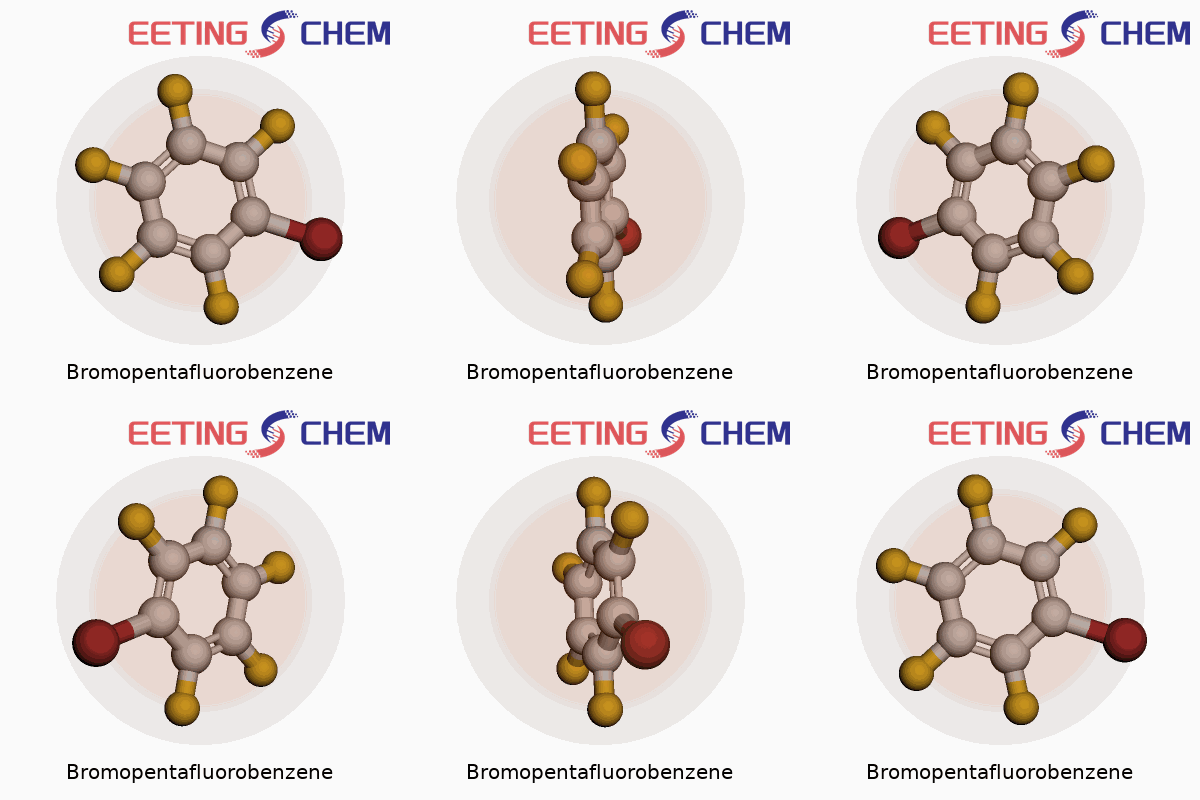
| Names | |
| Preferred IUPAC name | 1-bromo-2,3,4,5,6-pentafluorobenzene |
| Other names |
Pentafluorobromobenzene
Bromopentafluorobenzene 1-Bromo-2,3,4,5,6-pentafluorobenzene |
| Pronunciation | /ˌbroʊmoʊˌpɛntəˌflʊəroʊbɛnˈziːn/ |
| Preferred IUPAC name | 1-bromo-2,3,4,5,6-pentafluorobenzene |
| Other names |
Pentafluorobromobenzene
|
| Pronunciation | /ˌbroʊ.moʊˌpɛn.təˌflʊə.roʊˈbɛn.ziːn/ |
| Identifiers | |
| CAS Number | 392-60-1 |
| Beilstein Reference | 1366911 |
| ChEBI | CHEBI:50967 |
| ChEMBL | CHEMBL2036658 |
| ChemSpider | 232405 |
| DrugBank | DB14055 |
| ECHA InfoCard | 100.012.094 |
| EC Number | 205-995-7 |
| Gmelin Reference | 60843 |
| KEGG | C14339 |
| MeSH | D001942 |
| PubChem CID | 70221 |
| RTECS number | CU5950000 |
| UNII | 6CEP8N66RZ |
| UN number | UN1993 |
| CompTox Dashboard (EPA) | DJ2971WT3Q |
| CAS Number | '320-99-0' |
| 3D model (JSmol) | `3DModel:JSmol:C1(=C(C(=C(C(=C1F)F)F)Br)F)F` |
| Beilstein Reference | 1209122 |
| ChEBI | CHEBI:87315 |
| ChEMBL | CHEMBL1438766 |
| ChemSpider | 22401 |
| DrugBank | DB14006 |
| ECHA InfoCard | 100.008.364 |
| EC Number | '206-556-7' |
| Gmelin Reference | 8782 |
| KEGG | C19173 |
| MeSH | D001943 |
| PubChem CID | 75739 |
| RTECS number | CY9100000 |
| UNII | K99D52B7PO |
| UN number | UN3166 |
| CompTox Dashboard (EPA) | DTXSID3050278 |
| Properties | |
| Chemical formula | C6BrF5 |
| Molar mass | 260.00 g/mol |
| Appearance | Colorless liquid |
| Odor | Aromatic |
| Density | 1.789 g/mL at 25 °C (lit.) |
| Solubility in water | Insoluble |
| log P | 2.7 |
| Vapor pressure | 3.7 mmHg (25 °C) |
| Acidity (pKa) | -11.7 |
| Basicity (pKb) | 1.60 |
| Magnetic susceptibility (χ) | -77.5·10⁻⁶ cm³/mol |
| Refractive index (nD) | 1.427 |
| Viscosity | 1.27 mPa·s (25 °C) |
| Dipole moment | 2.47 D |
| Chemical formula | C6BrF5 |
| Molar mass | 260.00 g/mol |
| Appearance | Colorless liquid |
| Odor | Aromatic |
| Density | 1.674 g/mL at 25 °C (lit.) |
| Solubility in water | Insoluble |
| log P | 3.9 |
| Vapor pressure | 11 mmHg (20°C) |
| Acidity (pKa) | -12.5 |
| Basicity (pKb) | 15.1 |
| Magnetic susceptibility (χ) | -68.9×10⁻⁶ cm³/mol |
| Refractive index (nD) | 1.430 |
| Viscosity | 1.626 mPa·s (25 °C) |
| Dipole moment | 2.76 D |
| Thermochemistry | |
| Std molar entropy (S⦵298) | 367.6 J·mol⁻¹·K⁻¹ |
| Std enthalpy of formation (ΔfH⦵298) | -553.2 kJ/mol |
| Std enthalpy of combustion (ΔcH⦵298) | -3228.7 kJ/mol |
| Std molar entropy (S⦵298) | 221.6 J·mol⁻¹·K⁻¹ |
| Std enthalpy of formation (ΔfH⦵298) | -231.7 kJ/mol |
| Std enthalpy of combustion (ΔcH⦵298) | -3379.2 kJ·mol⁻¹ |
| Pharmacology | |
| ATC code | '' |
| Hazards | |
| GHS labelling | GHS02, GHS07 |
| Pictograms | GHS07 |
| Signal word | Warning |
| Hazard statements | H315: Causes skin irritation. H319: Causes serious eye irritation. H335: May cause respiratory irritation. |
| Precautionary statements | P261, P271, P273, P280, P304+P340, P312 |
| Flash point | 61 °C (142 °F; 334 K) |
| Autoignition temperature | 280°C |
| Lethal dose or concentration | LD₅₀ (oral, rat): >2000 mg/kg |
| NIOSH | Not established |
| PEL (Permissible) | Not established |
| IDLH (Immediate danger) | Not established |
| GHS labelling | GHS02, GHS07 |
| Pictograms | GHS07 |
| Signal word | Warning |
| Hazard statements | H302: Harmful if swallowed. H332: Harmful if inhaled. |
| Precautionary statements | Wash thoroughly after handling. Avoid release to the environment. IF ON SKIN: Wash with plenty of water. |
| NFPA 704 (fire diamond) | 1-0-0 |
| Flash point | 62 °C (closed cup) |
| Lethal dose or concentration | LD₅₀ Oral rat: >2000 mg/kg |
| NIOSH | CF8400000 |
| PEL (Permissible) | Not established |
| IDLH (Immediate danger) | Not listed |
| Related compounds | |
| Related compounds |
Chloropentafluorobenzene
Pentafluoroiodobenzene Pentafluorobenzene Nitropentafluorobenzene |
| Related compounds |
Pentafluoroiodobenzene
Pentafluoronitrobenzene Pentafluoroaniline Pentafluorophenol Hexafluorobenzene |


